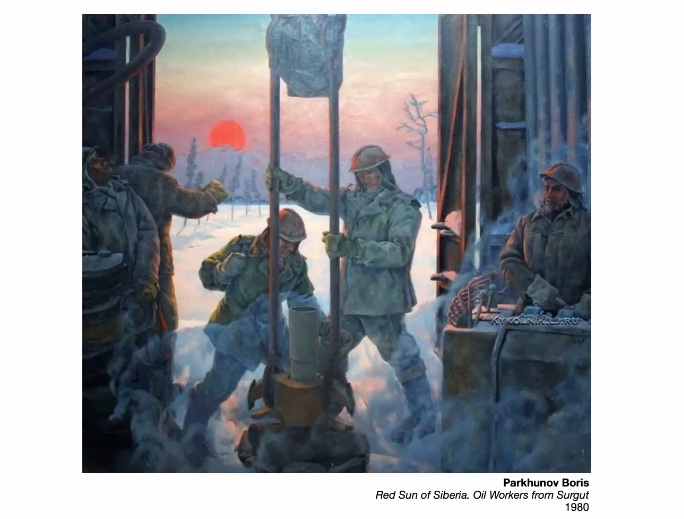
Digital Petrosalon on the presence and history of oil extraction and petroculture in Western-Sibiria and the post-soviet sphere
Conceived of and organized by Beauty of Oil in cooperation with Oxana Timofeeva and the research group “Imaginary Anthropocene: environmental knowledge production and transfers in Siberia in the XX-XXI centuries“ at the Center “Human, Nature, Technology” of Tyumen University and Goethe Institute Novosibirsk.
Participants: Evgeny Gololobov, Doctor of Historical Sciences, Vice-Rector for Research, Surgut State Pedagogical University. Fedor Korandey, Senior Researcher, Laboratory of Historical Geography and Regional Studies, Tyumen State University. Alexander Sorokin, head of Department of Russian History, Head of Research Center “Human, Environment & Technology”, University of Tyumen. Igor Stas, Senior Research Fellow, Laboratory of Historical Geography and Regional Studies, and investigator of the project “Imaginary Anthropocene: environmental knowledge production and transfers in Siberia in the XX-XXI centuries”, Tyumen State University. Oxana Timofeeva, Professor and Leading Researcher at Department of Sociology and Philosophy, European University of St. Petersburg, founding member of the project “Imaginary Anthropocene: environmental knowledge production and transfers in Siberia in the XX-XXI centuries”, Igor Chubarov, Professor of Philosophy at Tjumen State University. Per Brandt. Director of Goethe-Institute Novosbirsk, Alexander Klose, Beauty of Oil, Benjamin Steininger, Beauty of Oil, And students of Tyumen State University.
Programme
Per Brandt: Opening
Alexander Klose, Benjamin Steininger: Introduction
Fedor Korandey: And the Fourth will not be… How the Tyumen Oil region has become “the Third Baku”
Eugene Gololobow: Oil in cultural life Surgut 60ies 70ies 80ies
Ilya Kalinin: Soviet Oil and Russian Cosmism
Igor Stas: Oil cities in the Russian Arctic (based on materials from the West Siberian sector of the Arctic)
Benjamin Steininger: Oil history of Austria
Alexander Klose: Druschba
General Discussion
Event in English and Russian, Wed Dec 2, 12 – 3 pm CET on Zoom.
Нефть – это полезное ископаемое мирового значения. Двигатель внутреннего сгорания, самолет, пластмасса и синтетические удобрения уже стали частью мировой истории в контексте любой общественно-политической системы. По сути, весь переход нашей планеты в эпоху Антропоцена напрямую связан с использованием ископаемого топлива. В то же время глобальный масштаб приобрели и экологические проблемы, которые вынуждают человечество искать альтернативы углеводородам.
Тем не менее, исторический опыт добычи и использования нефти различается от региона к региону. Равно как и «модерн» – определение исторической эпохи, – «петромодернизм» не является унифицированным понятием. Нефть играет разную роль в капиталистической и социалистической экономических системах, в нефтедобывающих и нефтеперерабатывающих странах, в странах Запада и странах Востока, в Арктике и в Европе. И именно сейчас, когда мир начинает развитие в направлении отказа от ископаемых источников энергии, важно учесть все перечисленные перспективы для формирования комплексного представления о значении этой эпохи.